
Many ecommerce businesses eventually face the same question: should they continue relying on a responsive website or invest in a mobile app to improve customer experience and sales?
For years, responsive websites have been the standard approach for mobile commerce. They are accessible, easier to maintain, SEO friendly, and work across devices without requiring customers to download anything. For many early stage or low volume stores, a responsive website is often enough to support day to day operations.
Mobile apps, however, offer a very different experience. Unlike responsive websites that operate inside a browser, apps are built specifically for mobile devices. This allows businesses to create faster shopping experiences, deliver personalized engagement, simplify repeat purchases, and stay connected with customers through features like push notifications and loyalty programs.
As customer expectations around speed, convenience, and personalization continue to rise, many growing ecommerce brands are starting to realize that a responsive website alone may not be enough to maximize retention and repeat purchases.
The real question is no longer:
Mobile app or responsive website?It is:
At what stage does a mobile app become a competitive advantage for an ecommerce business?
In this guide, we’ll break down the key differences between mobile apps and responsive websites, where each performs best, and how ecommerce brands can decide which approach makes the most sense for their growth goals.
Mobile App vs Responsive Website: Quick Comparison
The choice between creating an app and a responsive website goes beyond aesthetics. In ecommerce, it has a direct impact on the customer experience, loyalty, and growth potential.
Though responsive websites are important for accessibility and SEO, mobile apps can be more effective in engaging customers and retaining them as loyal brand followers.
Below is a quick rundown of differences between the two based on various ecommerce aspects:
| Feature | Mobile App | Responsive Website |
|---|---|---|
| User Experience | Built specifically for mobile devices | Adjusts to different screen sizes |
| Speed & Performance | Faster due to local caching and native optimization | Depends on browser and internet speed |
| Push Notifications | Available | Limited browser support |
| Offline Access | Supported for some features | Requires internet connection |
| Personalization | Advanced behavior based experiences | Moderate personalization |
| Checkout Experience | Faster repeat purchases with saved preferences | More steps and form entry friction |
| Customer Retention | Stronger long term engagement potential | Lower direct re-engagement capability |
| SEO Visibility | Limited discoverability in search engines | Strong search engine visibility |
| Installation Required | Yes | No |
| Maintenance | Separate app updates may be required | Easier centralized updates |
Neither option is perfect. The right choice often depends on the stage of the business, customer behavior, and how heavily the brand relies on repeat engagement and retention.
For businesses focused primarily on discoverability and traffic acquisition, a responsive website may be sufficient. However, brands investing in customer retention, loyalty, and repeat purchases often see greater long term value from mobile apps.
However, brands investing in customer retention, loyalty, and repeat purchases often see greater long term value from mobile apps.
Want to see how a mobile app could improve retention, repeat purchases, and customer engagement for your store?
Try a mobile app free for 30 days and explore how growing ecommerce brands are creating faster, more personalized shopping experiences
When a Responsive Website May Be Enough
Every ecommerce business does not require a mobile app right away. For most ecommerce businesses, a responsive website is the optimal initial choice, particularly during the early stages of growth.
Responsive websites are cheaper to develop, quicker to deploy, and highly effective for businesses whose primary source of traffic and customer acquisition is organic searches and one time customers. Being device independent and not requiring downloads, they are also beneficial for the initial discovery of the brand.
For instance, many businesses with low purchase frequencies or longer purchase cycles can benefit from the implementation of a responsive website. The reason being that these customers are unlikely to visit regularly and therefore do not need a mobile app.
A responsive website might be sufficient for businesses that:
- Are still in the early stages of their ecommerce venture.
- Depend primarily on SEO, PPC, or social media for customer acquisition.
- Have low purchase frequency.
- Have low development or marketing budget.
- Require rapid deployment and easy maintenance.
For most ecommerce companies optimizing the speed of their website, enhancing navigation, and improving the checkout process can yield great results even when the company does not have a dedicated mobile app yet.
However, this equation tends to change when the ecommerce business starts to grow.
As customer acquisition costs continue to rise, more and more ecommerce companies shift their focus from one time purchases to retention, repeat purchases, and customer lifetime value. Mobile apps are where all of this becomes possible.
Unlike responsive websites, mobile apps enable brands to remain in constant touch with their customers via push notifications, personalization, loyalty programs, and faster repeat purchases. Such engagement is likely to improve retention and boost revenue.
The question is no longer
Do we need a mobile app or a responsive website?
The question for many ecommerce companies becomes
How do we build long term relationships with our customers in mobile commerce?
Can a Responsive Website Replace a Mobile App?
For many ecommerce businesses, a responsive website can successfully handle the core functions of mobile commerce, especially in the early stages of growth.
Modern responsive websites are faster, more flexible, and more mobile friendly than ever before. They allow customers to browse products, complete purchases, and interact with brands across devices without needing to install an app. For businesses focused heavily on search visibility, customer acquisition, and accessibility, responsive websites remain a highly effective foundation.
In many cases, a well optimized responsive website may be enough to:
- Reach new customers through SEO and paid traffic
- Provide a smooth mobile shopping experience
- Support basic personalization
- Handle standard ecommerce operations efficiently
However, the limitations of responsive websites often become more visible as ecommerce businesses scale.
The challenge is not usually around basic functionality. It is around long term customer engagement and retention.
Responsive websites primarily depend on customers returning voluntarily through search, ads, email campaigns, or direct visits. Mobile apps operate differently. Once installed, they create a more persistent connection between the brand and the customer through features like push notifications, saved preferences, loyalty programs, faster repeat purchases, and personalized in-app experiences.
This changes how brands interact with repeat customers.
For example, a responsive website may still convert first time visitors effectively. But mobile apps often reduce the friction involved in bringing existing customers back to browse, engage, and purchase again.
That difference becomes increasingly important as:
- Customer acquisition costs rise
- Repeat purchases become more valuable
- Competition for attention increases
- Brands focus more heavily on retention and customer lifetime value
So, can a responsive website replace a mobile app?
For some businesses, yes, especially those prioritizing accessibility, discoverability, and early stage growth.
But for ecommerce brands focused on building stronger long term customer relationships and increasing repeat engagement, responsive websites and mobile apps often serve different strategic purposes rather than replacing one another entirely.
Mobile App vs Responsive Site: Key Differences
Functionality – Mobile apps excel in functionality, providing access to device specific features like GPS, camera, and sensors, which can significantly enhance the user experience.
Fitness apps like Fitbit and Nike Training Club use the phone’s built in sensors (accelerometer, gyroscope) to track user activities like walking, running, or cycling. This sensor integration allows the apps to provide personalized health insights and feedback based on real time data
Speed – Mobile apps generally perform better than mobile responsive websites because they are built specifically for the platform (iOS or Android), making them faster and more efficient.
Unlike websites, which have to adapt to different screen sizes, apps are optimized for the device, reducing delays. Plus, apps can store data locally, allowing customers to access content quickly, even when they’re offline.
User Experience – Apps can send real time push notifications to users, keeping them engaged and informed about updates, offers, or events. This direct communication boosts engagement and creates a more personalized experience that mobile-responsive websites cannot provide.
Moreover, mobile apps let customers set preferences, save settings, and receive personalized content based on their behavior. But, this level of personalization and seamless experience isn’t possible with responsive websites, which lack the deep integration with device features and the ability to store user data in the same way apps can.
Mobile Apps Deliver Personalized Experiences and Save Time
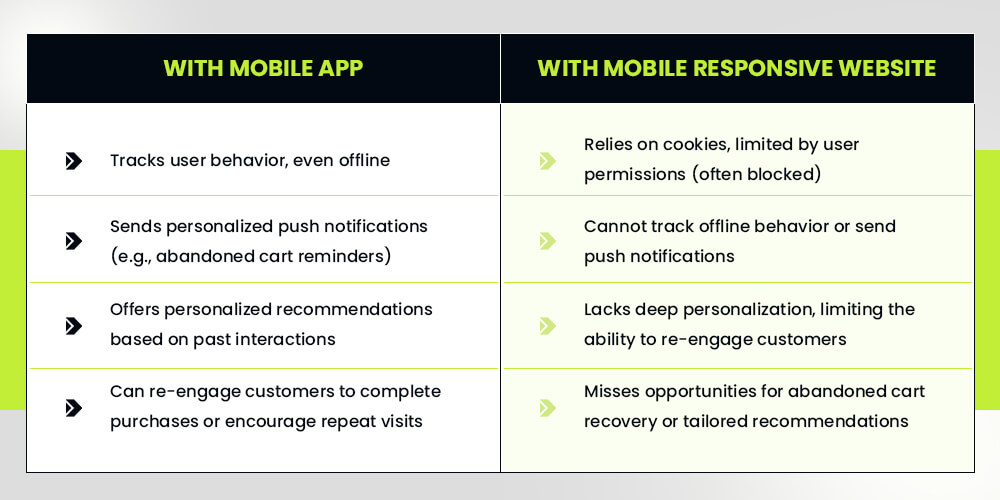
Mobile apps can collect detailed data about how users interact with them. They track behaviors like
- Which products do customers view
- How long they spend on each item
- The search terms
- Items they add to their cart but don’t purchase
- Browsing history
This data is leveraged to offer personalized recommendations, such as “You might also like” or “Recently viewed items“.
Why Mobile Responsive Websites Fail To Deliver Personalized User Experience?
Mobile responsive websites rely on cookies and browser based tracking, but when users deny cookie tracking (which is common due to privacy concerns), websites struggle to collect detailed data like product views and cart additions. This limits their ability to offer personalized recommendations, unlike mobile apps that gather deeper insights through direct device integration and permissions.
Mobile Apps Allow You To Directly Connect with Customers Anytime, Anywhere with Push Notifications
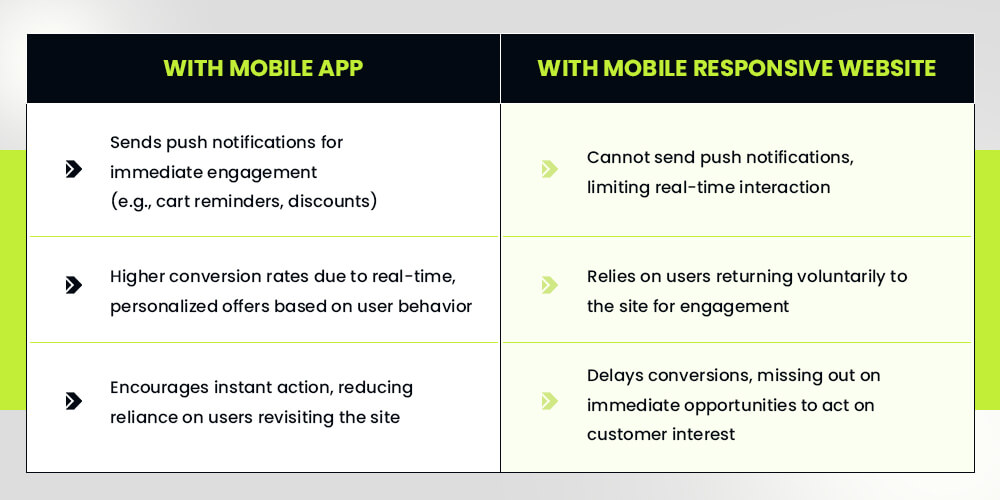
Mobile apps leverage push notifications to deliver targeted messages directly to users’ phones, enabling businesses to connect with customers in real time. These are time sensitive offers, reminders for abandoned carts, product updates, or personalized recommendations. Push notifications have a much higher open rate and lead to higher conversion rates.
Without a mobile app, businesses relying solely on mobile responsive websites miss out on push notifications. Hence, it lacks the ability to send instant, real time messages to customers. This means businesses must wait for customers to return to the website, it will delay the process and often results in lost conversion opportunities.
How Mobile Apps Boost Conversion Using Push Notifications
Imagine a shopper at an online clothing store browses through the latest jackets, adds one to their cart, and then decides to leave without completing the purchase. But just a few minutes later, they get a ping on their phone:
“You left a stylish jacket in your cart! Complete your purchase now and enjoy 10% off!“
The notification grabs their attention. They’re already thinking about the jacket, and now there’s an extra incentive. They tap the notification, and within seconds, they’re back in the app, completing the checkout. The beauty of push notifications is that they provide instant engagement, helping brands recover potential sales within moments of abandonment.
How Apps Boost Sales with Effective Remarketing
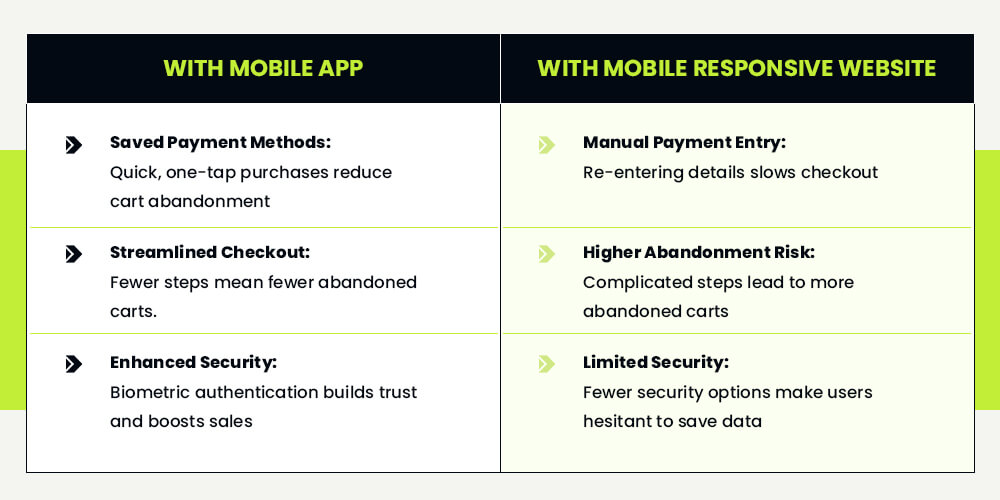
In-app messaging allows businesses to send highly personalized messages based on a user’s activity. For example, if a customer has shown interest in a particular category of products, the app can display recommendations such as, “You might also like…” or “Check out these new arrivals in your favorite style.”
This targeted approach increases the likelihood of a user returning to the app and making a purchase, which is more effective than the generic messaging typically used on websites.
Why In-App Messaging Is Most Effective Strategy
- Direct interaction: In-app messages appear directly within the app, which means users don’t need to leave or go through additional steps (such as opening an email or clicking on a link).
- Behavior based: The messages are triggered by specific user behaviors, making them more relevant and timely.
- Less intrusive: Since the messages appear while the user is already engaged with the app, they’re less likely to be ignored or dismissed compared to an email or ad.
Apps Enable Faster Checkouts and More Purchases But Mobile Responsive Website Can’t
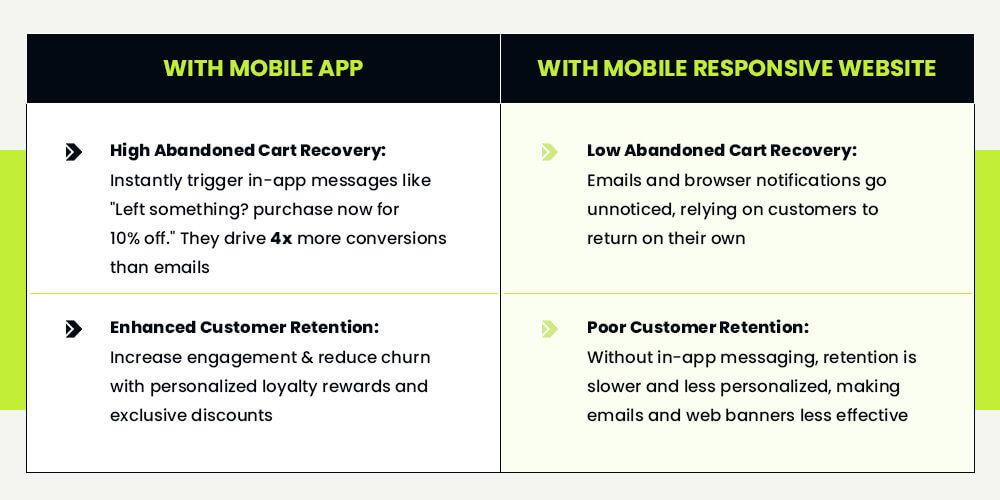
Mobile apps make checkout processes fast and smooth by eliminating unnecessary steps. It lets customers securely store payment details, enabling one click purchases without re entering card information.
In contrast, mobile responsive sites often require users to enter payment details each time, unless they’re logged into an account.
Re entering payment details on mobile responsive sites creates frustration and increases the risk of cart abandonment. Customers expect a quick, seamless checkout. Manually entering card details breaks that flow and adds friction, increasing the chances of cart abandonment.
With mobile apps, you’re creating a frictionless shopping experience that encourages customers to complete the purchase and reduce cart abandonment.
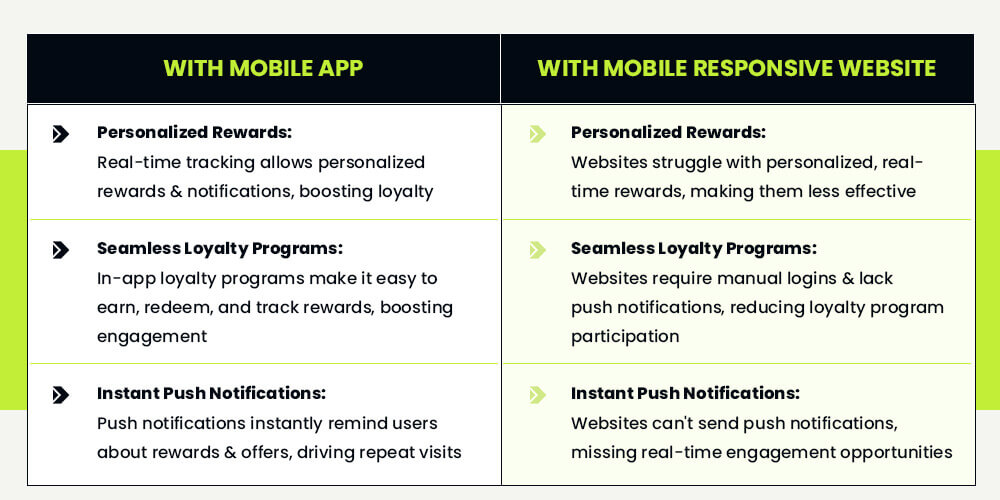
Mobile Apps Reward Loyal Customers and Encourage Them Coming Back
Businesses can easily set up loyalty programs within mobile apps where customers can earn points for purchases, referring friends, or simply interacting with the app. These points can be exchanged for rewards like discounts, free items, or special offers

Starbucks app allows customers to collect stars for every purchase, which can then be redeemed for free drinks or snacks. This simple system encourages customers to keep coming back, as they’re motivated by the rewards they earn with each use.
Customers enjoy earning points through apps because it feels like they’re getting extra value for their regular actions. They appreciate that they can trade those points for discounts or freebies.
Mobile App vs Responsive Website: Cost Considerations
Cost is one of the first filters ecommerce businesses apply when evaluating a mobile app versus a responsive website. But in practice, the real decision is less about upfront expense and more about which channel supports the economics of the business as it scales.
For many brands, a responsive website is the most practical starting point. It’s faster to launch, easier to manage, and allows teams to maintain a single experience across devices without introducing app adoption friction. For businesses still focused heavily on acquisition, SEO visibility, and early stage growth, responsive websites often offer the best balance of reach and accessibility. They are also typically faster to manage and operationally simpler to maintain.
Mobile apps operate differently.
They are not simply another storefront layer. They are long term retention infrastructure.
Beyond development, apps require continuous optimization, platform maintenance, engagement planning, and ongoing iteration around user behavior. That investment rarely pays off through acquisition alone. The value compounds when retention, repeat purchasing, and customer lifetime value begin driving a larger share of overall profitability.
This is typically where the economics start to shift for ecommerce brands that:
- Generate a large percentage of revenue from mobile traffic
- Have strong repeat purchase patterns
- Depend on loyalty and customer retention to sustain margins
- Want to reduce reliance on rising paid acquisition costs
- Are actively focused on increasing long term customer value
In these environments, mobile apps often create advantages that responsive websites struggle to replicate consistently.
Re-engagement becomes more direct. Repeat purchasing requires less friction. Personalization improves. Customer relationships become easier to maintain through owned communication channels like push notifications rather than relying entirely on email algorithms or paid retargeting.
That distinction matters because responsive websites and mobile apps are ultimately optimized for different growth priorities.
Responsive websites are exceptionally effective for discoverability, accessibility, and customer acquisition. Mobile apps, by contrast, tend to perform strongest as retention and engagement channels once a business has an established customer base worth nurturing over time.
Which is why the decision should not be reduced to:
Which option costs less?
The more useful strategic question is:
Which channel better supports the next stage of growth for the business?
For many ecommerce brands, responsive websites remain the operational foundation of mobile commerce. Mobile apps become increasingly valuable when repeat customers, retention efficiency, and long term customer revenue begin contributing more meaningfully to sustainable growth.
Not sure whether your business is ready for a mobile app yet? Try a mobile app free for 30 days
to evaluate how it impacts repeat purchases, customer retention, and long-term customer engagement for your brand.
Which Ecommerce Businesses Benefit Most from Mobile Apps?
Not every ecommerce business needs a mobile app immediately.
For many brands, a responsive website is enough to support SEO visibility, customer acquisition, and early stage growth. But as retention and repeat customer revenue become more important, many ecommerce businesses begin evaluating mobile apps as long term engagement channels supported by evolving mobile app retention benchmarks.
This is especially true for businesses where customers interact with the brand repeatedly rather than making one time purchases.
Fashion and Apparel Brands
Fashion ecommerce is highly engagement driven. Customers often return multiple times to browse new arrivals, seasonal collections, price drops, and personalized recommendations before completing a purchase.
Mobile apps help fashion brands stay consistently visible during this decision making cycle through push notifications, wishlists, saved preferences, and app exclusive offers. Many brands also rely on push notification engagement strategies to bring shoppers back during high intent browsing moments.
As a result, fashion brands can create stronger repeat engagement and faster purchase journeys without relying entirely on customers coming back through ads or search.
Grocery and Quick Commerce Businesses
For grocery and quick commerce brands, convenience directly impacts retention.
Customers frequently reorder the same or similar products, which means even small amounts of friction can interrupt repeat purchasing behavior. Mobile apps simplify this process through saved carts, reorder functionality, real-time delivery updates, and faster checkout experiences.
Instead of restarting the shopping journey each time, customers can complete repeat purchases quickly and with less effort. Many grocery brands also use behavior based push notification campaigns to improve repeat ordering consistency and customer re-engagement.
Beauty and Skincare Brands
Beauty and skincare brands rely heavily on personalization, product discovery, and long term customer relationships.
Customers regularly return to replenish products, explore new launches, or browse recommendations aligned with their preferences and routines. Mobile apps support this by making personalized experiences more accessible through loyalty programs, targeted recommendations, tutorials, and customized engagement.
This ongoing visibility helps brands stay connected between purchases and encourages stronger repeat buying behavior over time.
Health, Wellness, and Supplement Brands
Supplement and wellness brands naturally operate around recurring purchase cycles.
Customers buying vitamins, protein supplements, or wellness products often reorder at predictable intervals. Mobile apps help reinforce this behavior through refill reminders, subscriptions, personalized recommendations, and faster repeat checkout experiences.
This aligns with broader app retention and re-engagement trends showing how consistent engagement channels can strengthen long term customer retention.
Businesses With Strong Repeat Purchase Behavior
In general, mobile apps tend to create the most value for ecommerce businesses where customers:
- Purchase frequently
- Engage with the brand regularly
- Respond to promotions and reminders
- Participate in loyalty or rewards programs
For businesses focused primarily on first time customer acquisition or lower repeat purchase frequency, a responsive website may still remain the more practical primary channel.
However, as retention and repeat customer revenue become more important to growth, many ecommerce brands begin viewing mobile apps less as an additional sales platform and more as a long term customer engagement and retention channel.
Final Verdict: Mobile App or Responsive Website?
Mobile apps clearly outperform mobile responsive websites in terms of user experience. It also allows businesses to create deeper connections with customers. By leveraging app specific data like browsing history and purchase behavior.
With all these advantages, it’s clear that businesses that invest in mobile apps can provide a superior experience, increase customer retention, and ultimately drive higher sales. In an era where customers expect convenience and personalization, mobile apps are no longer optional, they’re essential for staying competitive and staying a step ahead.
About The Author

I love navigating the world of SaaS with finesse. As an SEO enthusiast and seasoned Copy Writer, I'm here to transform tech-speak into compelling narratives that resonate with online merchants. With a penchant for alliteration and a touch of humor, I bring a unique flair to SaaS content.
Related Posts

Mobile App Engagement Strategy for Shopify Merchants: Turning User Engagement Metrics Into Action
In the previous blog of our “Mobile App User Engagement”…

How Brands Turn Mobile App Engagement Into Long-Term Customer Retention
In the first two parts of our Mobile App Engagement…

Top Mobile App User Engagement Metrics Every Shopify Merchant Should Track
Every day, mobile apps collect and produce vast amounts of…


